Giving instructions
BeginnerAlmost everything you say has the same shape, and there are only four things you can ask an aircraft to change.
Step 3 of 5 · Learn to control
The shape of a transmission
Section titled “The shape of a transmission”The callsign goes first, every time — that is how the game knows which aircraft you mean. Then come the instructions, in the order you want them flown. If the recognized airline and flight number point to different aircraft, the pilot asks again instead of applying the clearance to the wrong flight.
Hold CONTROL while you speak, release when you finish. Three instructions or fewer per transmission is recognised most reliably.
Where to point it — headings
Section titled “Where to point it — headings”Headings are compass directions from 001 to 360, always said as three separate digits: “one three zero” for 130.
Iberia one two three four, turn right heading one three zero
The aircraft turns onto that heading and stays on it until you say something else. Steering aircraft this way is called vectoring, and the headings themselves are vectors.
Where to go — direct to a fix
Section titled “Where to go — direct to a fix”A waypoint (or fix) is a named point in the sky — RULOS, CASPE. Send an aircraft direct to one and it navigates there itself.
Iberia one two three four, fly direct RULOS
Use a heading when you want the nose pointed exactly where you need it. Use direct when you want the aircraft back on a known path — its route, or the approach. Most sessions mix both constantly. After vectoring, fixes still ahead in the aircraft’s stored route remain available. You can also spell any real three- or five-character fix or VOR in the current sector exactly; an unknown identifier still makes the pilot ask again. Not in 0.6.1.24
How high — altitude
Section titled “How high — altitude”Down low, height is measured in feet above sea level. Up high it is measured in flight levels — the altitude divided by a hundred, so flight level 100 is roughly 10,000 feet.
Iberia one two three four, descend altitude five thousand feet
Iberia one two three four, descend flight level one zero zero
You do not have to work out which one to use. Give a value and the game picks feet or flight level from the airport’s transition altitude.
QNH is the local air pressure setting. Altimeters measure height by pressure, and pressure moves with the weather, so everyone in your sector uses the same number — yours. It sits on the top bar, and you pass it on like this:
Iberia one two three four, QNH one zero one six
How fast — speed
Section titled “How fast — speed”Speed is your spacing tool. A line of arrivals at the same speed keeps even gaps; a slower aircraft absorbs delay without leaving its route; and everything has to be slow enough before the runway.
Iberia one two three four, speed two two zero knots
Up in the cruise, speed is given as a Mach number instead — say the digits one at a time after “mach decimal”:
Iberia one two three four, speed mach decimal seven eight
When you are done managing it, hand speed back:
Iberia one two three four, resume managed speed
Listening to the answer
Section titled “Listening to the answer”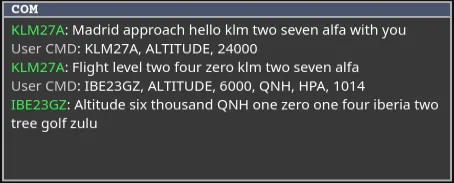
The pilot reads every instruction back. If the readback matches what you meant, it worked — that is the whole confirmation loop.
The frequency picks up your pace. Transmit back to back, or work a lot of traffic, and pilots speak a little faster. They also key up sooner after each other. It all settles back down as the frequency quietens. What they say never changes — only how quickly they say it. Not in 0.6.1.24
Open COM from the top bar to read the exchange as text. It shows what the game heard, which is the fastest way to find out why something did not work.
When the game is not certain about a waypoint, procedure or runway, it asks rather than guessing. Answer affirm, negative, or simply restate the clearance — a corrected value is applied on the spot. If the pilot still cannot make out a waypoint, it asks you to spell it phonetically, and every spoken question gives you a fresh window to answer. Confirmed pronunciations are remembered for that airport; press Shift+K to review, forget or reset them.
While a direct-to or descend-via question is open, the aircraft holds the whole clearance. Nothing from that transmission takes effect until your answer resolves it.
Another pilot’s readback can wait behind that question. When the clarification ends, held readbacks return once, in their original order. A stale or cancelled one is dropped instead of being played late or duplicated. Not in 0.6.1.24
When you get it wrong
Section titled “When you get it wrong”Say disregard within about ten seconds and the last instruction is cancelled:
Iberia one two three four, disregard
After that window, just give a new clearance — it replaces the old one anyway. And if the game keeps mishearing you, a Voice not working? helper appears with the microphone test and voice settings. It never changes your settings behind your back.
Every command, with its exact wording, lives in All commands.