Start here
BeginnerYou are the controller. Aircraft arrive at the edge of your screen already flying their routes, and your job is to keep them apart and get them to the runway — by talking to them.
Step 1 of 5 · Learn to control
The whole game, in four beats
Section titled “The whole game, in four beats”You hold a key, say an instruction, and a pilot reads it back and flies it. That loop is the entire game. Everything else on these pages is detail about what you can say and when.
There is no penalty for getting it wrong, no score counting down, and no clock you have to beat. Traffic waits for you.
What you need
Section titled “What you need”- A microphone. Any headset or laptop mic works.
- Roughly ten quiet minutes for the first session.
- No prior air traffic control knowledge. This path assumes none.
Speech recognition runs on your own computer. Voice recordings are never sent automatically. If you opt into diagnostics, the game may send redacted command text and parser results; audio can leave your computer only when you explicitly include the latest failed clip in a local diagnostic export and share that ZIP yourself.
The first launch takes a few minutes
Section titled “The first launch takes a few minutes”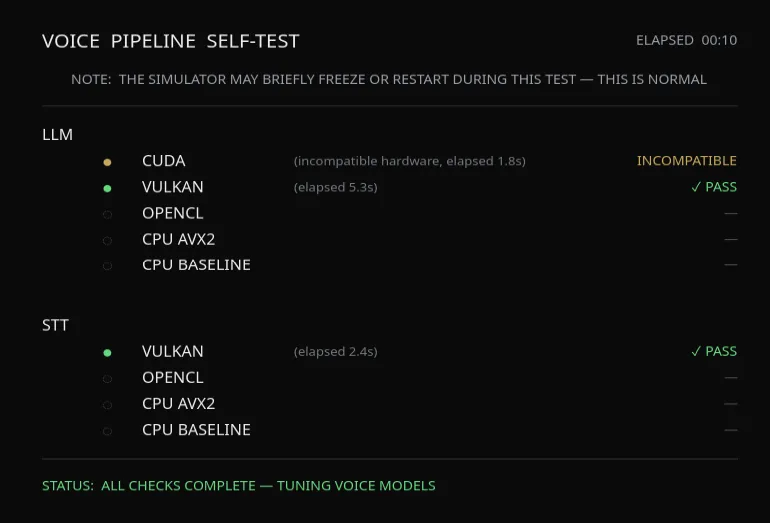
- Speech recognition — hearing your words.
- Command understanding — turning them into instructions.
- Pilot voices — the readbacks you hear.
The first time you start the game it tests your computer and tunes those three things to it. Let it finish. The result is remembered, so every later start goes straight to the main menu.
A dedicated graphics card makes these run faster, but is not required.
What the path covers
Section titled “What the path covers”Five short pages, in order. Each one ends with a link to the next.
- Start here — you are on it.
- The radar screen — what you are looking at, and which aircraft are yours.
- Giving instructions — headings, altitudes, speeds, and how to say them.
- Procedures and approaches — the published routes traffic already follows.
- Your first session — set one up and give your first three clearances.
After that, Playing the game covers every screen in detail, and All commands is the lookup table you keep open while you play.